Objective Canvas
Chat on the left. The plan on the right.
Select any passage to refine just that part, use one-click shortcuts for safety, recovery and acceptance tests, and restore any version.
Describe the outcome, constraints and success criteria. RoboRapid's AI copilot turns them into verifiable robot tasks you can adapt across robot brands, tools and production lines — then commission in the setup that fits, from cloud to fully on-prem.

Stop hand-coding waypoints. Describe what an automated robotic cell should achieve, and let RoboRapid handle the how — transparently.
Co-write it with an AI copilot on a live canvas. Ground it in CAD, SOPs, demo videos and cited best practices.
Readable actions, AST-checked in a sandbox and solved with deterministic 4-tier IK in the tool frame.
Execute over ROS 2 and watch every move in the real-time robot view. Each run becomes a synchronized RGB-D and robot-state episode.
Select any passage to refine just that part, use one-click shortcuts for safety, recovery and acceptance tests, and restore any version.
Eye-in-hand and overhead RGB-D streams from an electronics assembly cell, side by side with live 6-DoF detections, depth probes and joint telemetry straight from ROS 2.
Eye-in-hand and eye-to-hand RGB-D, fused for sub-millimetre alignment and 6-DoF part poses.
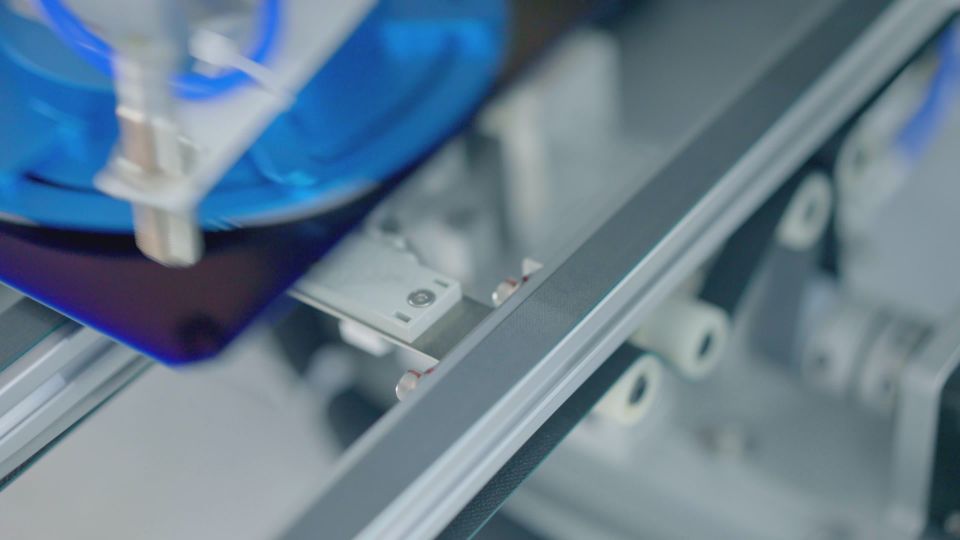
ROS 2 and MoveIt 2 native, through standard ros2_control trajectory controllers.
Twelve providers — frontier APIs or fully local weights for air-gapped plants.
Synchronized dual RGB-D and robot telemetry at 30 Hz, curated and exported to the formats your training stack already speaks.
Programming an autonomous robotic cell should take an afternoon — not a quarter.
Open the Studio, describe the outcome, and watch the policy take shape beside it.